4.8 Trusted Shops 22.167 reviews
Free Shipping from 149,-
1,000,000+ satisfied customers preceded you
Celebrating our 10th anniversary this year
Free Shipping from 149,-
4.8 Trusted Shops 22.167 reviews
Free Shipping from 149,-

Difference between a sauté pan and a wok pan

Difference between a sauté pan and a wok pan
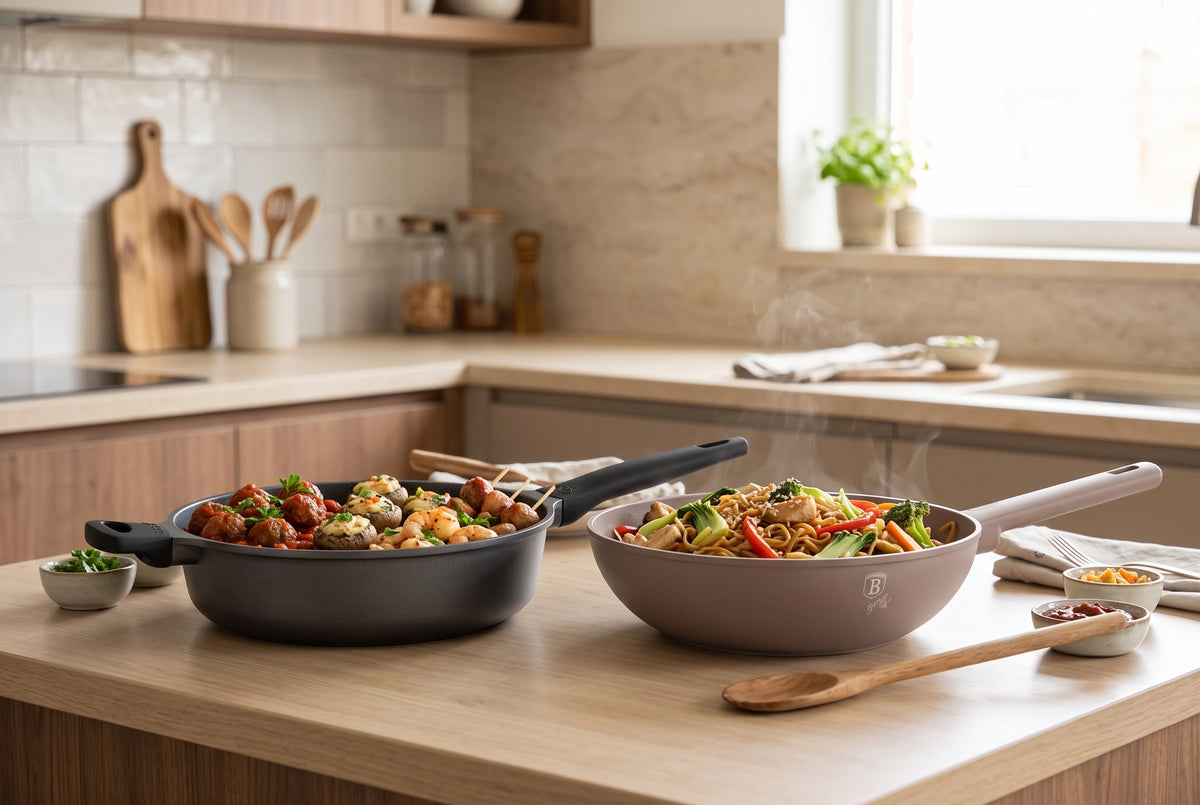
What do you notice when you put a sauté pan and a wok side by side?

What do you notice when you put a sauté pan and a wok side by side?

This is how the sauté pans and woks we currently offer differ.

You mainly use a sauté pan for frying and then making a sauce or a one-pot dish. The wall is tall and stands straight or flares out slightly. For pans ø 24 to 28 cm the base measures 16.5 to 22 cm, where the product page lists it. You hold the pan by a handle, sometimes with an extra helper handle, or by two side handles, and 9 of the 16 come with a lid.

A wok is mainly for stir-frying, and its high wall slopes outward from the base. That base measures 13.5 to 18 cm for woks ø 24 to 36 cm, again where the product page specifies it. Usually you handle a wok by a long handle, but the Blackwell Wokpan / Wadjan Gietijzer ø 32 cm has two ears. A lid is included with 2 of the 19 individual woks.

How big the difference at the base is becomes clear with the SCANPAN Hapjespan Classic Induction ø 24 cm and the SCANPAN Wokpan Classic Induction ø 24 cm. They come from the same line and are both 24 cm with the same standard non-stick coating. The sauté pan stands on a base of 18.2 cm, the wok on 14.5 cm. So less food fits on the bottom of the wok at once.

You don’t only use a wok for stir-frying: steaming and deep-frying are also among what you can do with a wok.

Is wokking the same as stir-frying?

Is wokking the same as stir-frying?

In both you do the same in the pan: you quickly fry small pieces of meat and vegetables on high heat and keep them moving. The difference is in the heat underneath.

Our pan expert compares the burner under a wok in a Chinese restaurant to a jet engine. No home cooktop reaches that power: not a gas stove, even with an extra-large burner, and not an induction cooktop either. On gas some of the heat is also lost along the wok’s high wall. With too little heat minced meat will steam instead of sear, and vegetables only begin to brown after a long time.

So you can also stir-fry at home in a pan with a flat bottom, like a frying pan or a sauté pan.

Wok or sauté pan: which suits your cooktop?

Wok or sauté pan: which suits your cooktop?

Besides a frying pan and a sauté pan, a wok is not our first recommendation in the shop. The reason largely depends on your cooktop.

On a regular gas stove the frying pan often has the edge

Because a frying pan is flatter, it catches more flame above the burner than a wok, according to our pan expert. A sauté pan also has a wide, flat base and can therefore replace a wok for stir-frying on gas just as well. If you already have a wok with a good non-stick coating, you can continue cooking with it on gas without issue.

On a flat induction cooktop a wide base is an advantage

An induction cooktop heats the pan via the part that lies on the glass, and with a wok that’s the narrow base. For stir-frying on a flat surface you’ll therefore often choose a sauté pan rather than a wok.

If you still want a wok on a flat cooktop, our pan expert looks for a non-stick coating and a flat base. With such a base the wok sits stably on the glass. The pan must also be large enough to hold everything at once. Those three points help when comparing the woks we recommend for induction.

When is a wok worth it?

When is a wok worth it?

With a powerful burner under your wok you achieve the heat a carbon steel wok without a coating is meant for. We currently have one of those woks: the Blackwell Wokpan Carbon Staal ø 30 cm. Before first use such a wok must be seasoned, and you will lose the seasoned layer in the dishwasher.

According to our pan expert, a cooktop with a wok zone is also suitable: it has a recessed area where the wok fits. You don’t see those cooktops often.

Can you also simmer something in a wok?

Can you also simmer something in a wok?

You can simmer in a wok too, but most woks don’t come with a lid. Without a lid a lot of moisture evaporates from your sauce. For a sauce or one-pot dish that needs to finish cooking gently after frying, a sauté pan is more convenient, because you much more often get a lid with it.

Our pan expert mainly recommends a casserole pan for the stew that needs to cook much longer than a sauce. In the comparison of casserole pan and sauté pan you can see where one pan stops and the other begins.

If you still want to do everything in a wok, there are also woks with lids, such as the Beka Wokpan met glazen deksel Pro Induc ø 28 cm. There you stir-fry on a ceramic layer and then let the dish finish cooking under the glass.

What does a frying pan do differently than a wok?

What does a frying pan do differently than a wok?

Of the three pans, a frying pan is the flattest, with a low rim and a wide base. A pancake or a fried egg lies completely flat there. On the narrow base of a wok, with its sloping wall, that doesn’t work well.

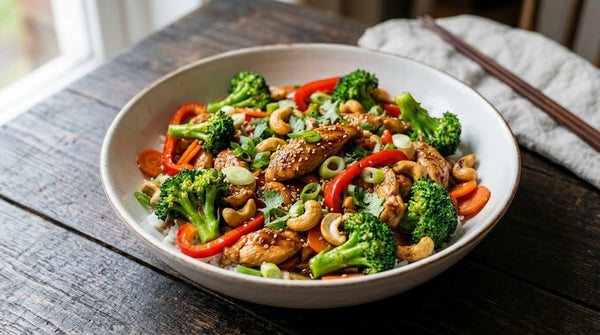
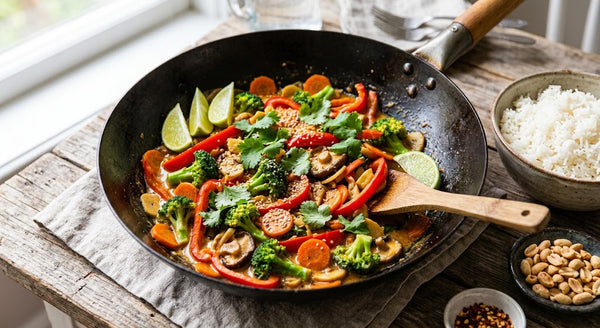
For our quick stir-fry with chicken and cashews you may choose between a wok and a large frying pan. If you use a frying pan, take the largest one you have so the pieces lie side by side on the base.

Check the sauté pans in our range per pan to see if a lid is included, especially if you also want to simmer in it.

Related products

Related howto's

Related recipes